Once a policy has been posted, it can only be changed by proceeding with a formal Endorsement.
A typical scenario for an endorsement is when some aspects of the coverage have changed, (variation of the Sum Insured or in the policy extensions, for example) but endorsements can also be used to correct basic errors in a previous policy version (wrong registration number or situation of address).
In case of issues with a policy version that has already been endorsed or renewed, this version can no longer be corrected by endorsement, being now expired and replaced by a newer version.
Two special functions are available in JAVLN.
Financial Adjustments and Premium Adjustments.
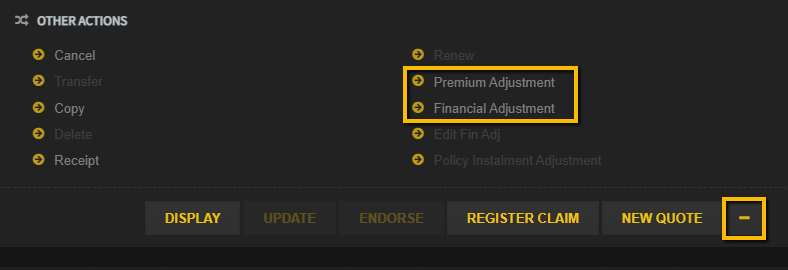
Both adjustments provide a way of making financial corrections (adjustments) from the Policy section of JAVLN directly into the Accounts section.
Both Adjustment types can be used to correct the Policy premium, for example.
The difference between the two is that :
When using a Financial Adjustment, many of the normal calculations are bypassed (Commissions and taxes, for example), so you have greater control over the values that will be posted, while other associated values are still automatically calculated, eg. Tax on Commission.
Premium Adjustments are used to add (or subtract) a one-off amount to a policy's premium while keeping JAVLN’s normal calculations active on the adjustment.
In this way, JAVLN will automatically calculate values for any applicable agent commission, taxes & levies etc. (while, as said before, these associated values are not calculated with a Financial Adjustment).
It is easiest to think of these adjustments as "out of sequence endorsements". They have the ability to change premium and details in locked versions.
These special financial policy versions cannot be endorsed further or have claims loaded against them.
Both types of adjustments result in a new version of a policy being created, with an added suffix of P if it is a Premium Adjustment or A if Financial Adjustment.
Since Adjustments are not part of the regular policy lifecycle, the changes made on the Adjustments won’t affect the values of the next endorsement or renewal.
For example, the standard Premium charged was originally $1000. The New Business is not the current version; it was endorsed due to a wrong situation of risk. The Premium of the New Business is adjusted to $1200 by creating a 200$ Adjustment.
On Renewal the original value of $1000 will still be used.
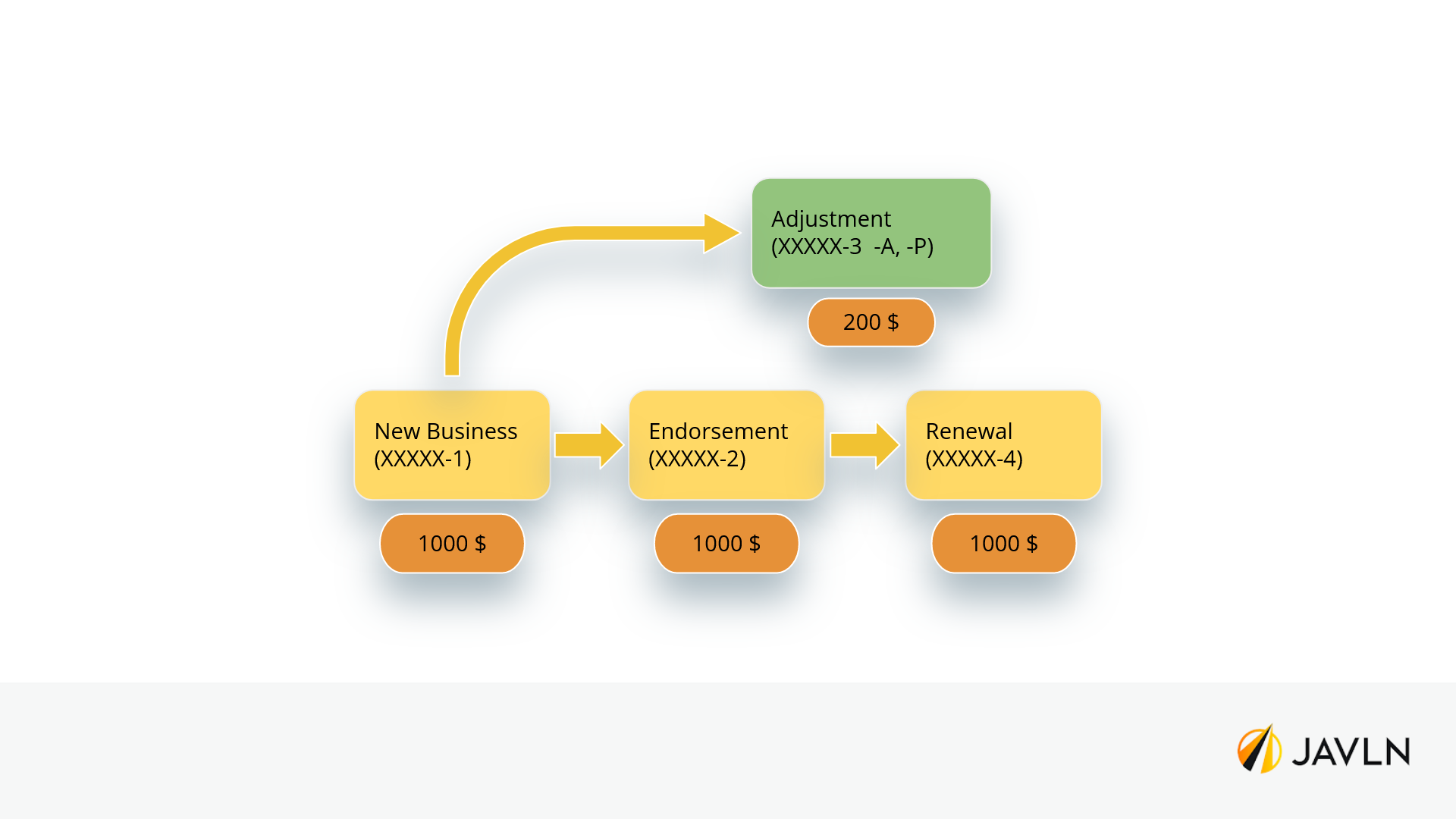
For this reason, before using an Adjustment to correct an error, make sure that the current version reflects the correct state of the policy (annual premium, commissions, taxes etc).
If not, firstly endorse the policy to correct it, then use the appropriate Adjustment to correct any differences in the accounts. The renewal will then inherit the correct values.
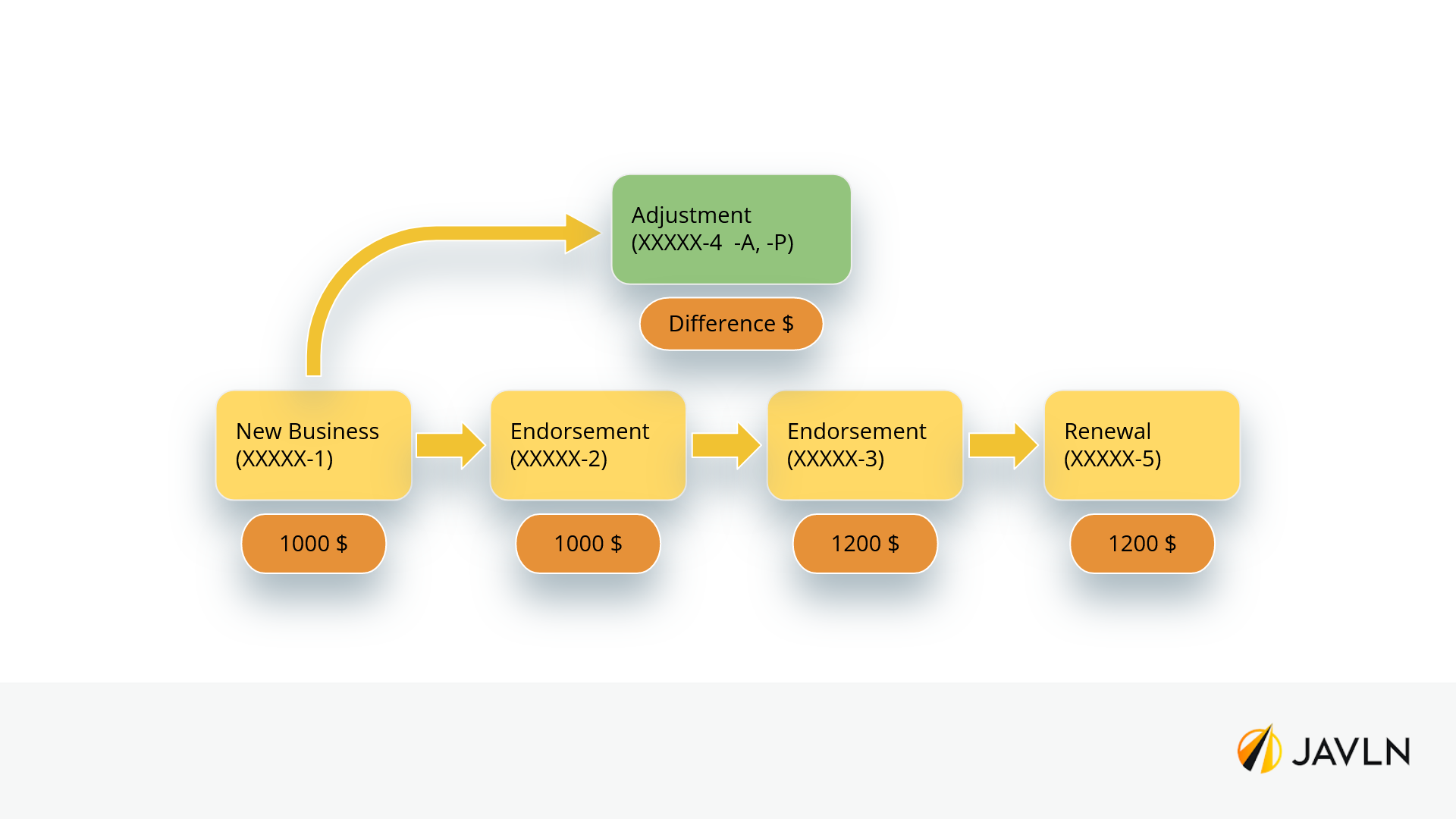
The financial impact of any change is posted onto the current open accounting period, not the accounting period the error occurred in (unless that is the current one), because usually that accounting period has been reconciled and closed.
Was this article helpful?
That’s Great!
Thank you for your feedback
Sorry! We couldn't be helpful
Thank you for your feedback
Feedback sent
We appreciate your effort and will try to fix the article